
- Prism Media
- Saturday, June 1st, 2019
- 773 views
- no Comments
Character Design Career Path: From Concept Art to Studio Work
Character Design Career Path: From Concept Art to Studio Work
Prism Media Animation Insight | Career Guide 2026 | Character Design
Every animated film, game, and franchise starts with a character that doesn’t exist yet — and someone has to invent how that character looks, moves, and feels before a single frame is animated. Character design sits at a unique intersection of illustration, storytelling, and personality design, and it’s one of the most creatively demanding — and creatively rewarding — specializations in the animation and gaming pipeline.
At Prism Media Animation, our Animation & VFX program in Bhubaneswar covers character design as a core foundation, because strong character design skill strengthens everything downstream in an animation pipeline. Here’s a realistic look at what it takes to build a career in this specific craft.
What Does a Character Designer Actually Do?
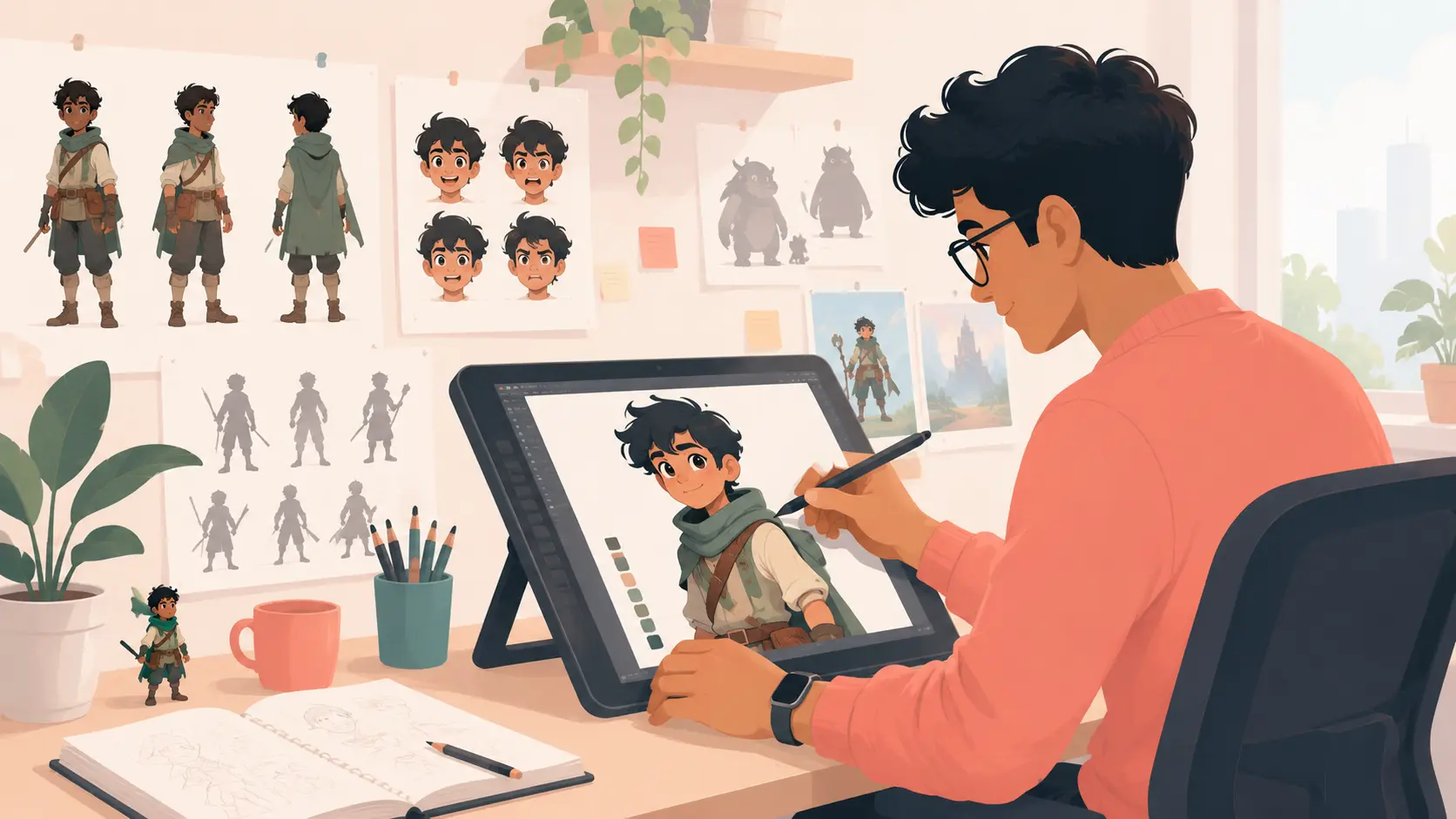
A character designer translates a written or conceptual description — a brief, a script, a personality outline — into a visual identity: silhouette, proportions, color palette, costume, and expression range. Unlike a concept artist working on environments or props, character designers focus specifically on personality made visible. A well-designed character should be readable as a silhouette alone, and should communicate something about who they are before they ever speak or move.
9 Steps to Building a Character Design Career
1. Build Strong Traditional Drawing Fundamentals First
Anatomy, proportion, and gesture drawing form the foundation every strong character designer builds on, regardless of whether their final style is realistic or heavily stylized. Skipping fundamentals to jump straight into a “cool style” almost always shows up as weak, inconsistent character work later.
2. Study Silhouette Design Specifically
A strong character design should be recognizable from silhouette alone — this is one of the most tested principles in professional character design and a common exercise recruiters look for in a portfolio. Practice designing characters that read clearly even without color or detail.
3. Learn to Design for Personality, Not Just Appearance
The strongest character designers think about who a character is — brave, cowardly, mischievous, wise — and let that personality drive every visual choice, from posture to costume to color. Designs that look good but don’t communicate personality tend to feel generic, even when technically well-executed.
4. Master Digital Painting Tools
Photoshop remains the most widely used tool for character concept art and digital painting across Indian studios. Procreate is a strong alternative for artists who prefer working on tablet devices. Either way, comfort with digital painting workflows is essential for professional-speed output.
5. Understand Costume and Prop Design as Part of Character Work
A character’s clothing, accessories, and props aren’t separate from their design — they’re extensions of personality and function. Strong character designers think through practical questions: what would this character actually wear, carry, or use, given who they are and where they exist.
6. Learn Basic 3D Software for Turnaround and Model Sheets
While character design is primarily a 2D illustration skill, understanding how your designs will be interpreted by a 3D modeler — through clean turnaround sheets and clear construction — makes you significantly more valuable in a production pipeline. Basic familiarity with Maya or Blender helps here, even without deep 3D expertise.
7. Explore AI Tools for Rapid Iteration, Not Final Output
Tools like Midjourney are increasingly used by character designers for rapid exploration of design directions before refining a final concept by hand. Studios still expect the final polished design and model sheets to reflect genuine illustration skill — AI accelerates exploration, not final craft.
8. Build Range Across Different Character Types
A strong character design portfolio typically shows range — heroes, villains, side characters, creatures, stylized and semi-realistic designs — rather than only one type repeated. This demonstrates versatility that recruiters and studios specifically look for.
9. Present Your Work With Model Sheets, Not Just Hero Shots
Professional character design portfolios include turnaround sheets, expression studies, and pose variations — not just a single polished illustration. This shows production-readiness, which is exactly what separates a portfolio that gets you hired from one that just looks nice on Instagram.
Where Character Designers Actually Work
- Animation studios (film, series, and streaming content)
- Game development studios
- Comic and graphic novel publishers
- Toy and merchandise design companies
- Freelance concept art for indie studios and creators
Gaming studios in particular have become a major hiring source for character designers in India, driven by the rapid growth of India’s domestic gaming industry alongside international outsourcing work.
Character Design vs Concept Art: What’s the Difference?
Concept art is a broader field covering environments, props, vehicles, and overall visual development for a project — character design is a specialization within it, focused specifically on characters. Many professionals start as generalist concept artists and specialize into character design once they discover it’s where their strongest skill and interest lies.
Frequently Asked Questions About Character Design Careers
Do I need to be a great traditional artist to become a character designer?
Strong drawing fundamentals — anatomy, gesture, proportion — are essential, but you don’t need to work traditionally forever. Most professional character designers work primarily in digital painting tools once fundamentals are solid.
Is character design only useful for animation and film?
No — gaming, comics, merchandise design, and increasingly branded mascot and marketing work all rely on character design skill, giving the specialization more career flexibility than it might initially seem.
How is a character design portfolio different from a general illustration portfolio?
A character design portfolio should show model sheets, turnarounds, and expression studies — not just single polished illustrations — to demonstrate that your designs are production-ready, not just visually appealing.
Can AI tools replace character designers?
Not for professional, production-ready work. AI tools help with rapid early-stage exploration, but studios still require final designs with genuine illustration craft, consistency, and production-ready model sheets that AI alone cannot reliably produce.
Want to Build a Career in Character Design at Prism Media Animation?
Explore professional training in:
- Animation & VFX
- Graphic Design
- Video Editing & Motion Graphics
Prism Media Animation – Learn. Create. Transform.

Prism Media
Search
Categories
- Animation (9)
- Computer (2)
- graphic design (6)
- Photography (2)
- Uncategorized (6)
- Visual effects (2)
Latest Post
-
Monday, February 2nd, 2026
10 Things You Need to Know About a 3D Animation Career in 2026
-
Thursday, October 3rd, 2024
10 Software Tools Every 3D Animation Student Must Learn in 2026
-
Tuesday, July 25th, 2023
-
Monday, December 26th, 2022
Things to Check Before Choosing a 3D Animation Institute in Bhubaneswar
-
Saturday, July 9th, 2022
Book a Free Demo
Experience the difference with our programs! Book a free demo to explore how our courses can help you achieve your academic and career goals. Don't miss this opportunity! Schedule your free demo today and take the first step towards a brighter future!
Book Now© Copyright 2026 by PrismMedia
0 Comment